

THE PRACTICAL VIEW
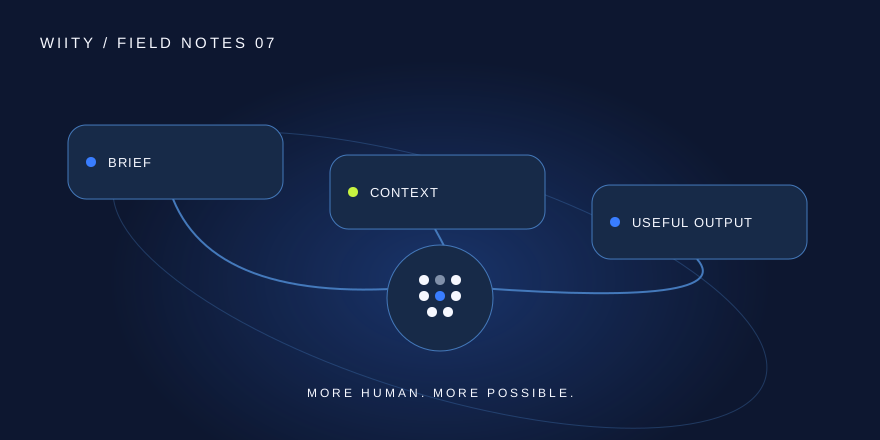
Treat a prompt as a brief someone else must be able to follow and a reviewer must be able to check. The evidence matters more than the cleverness of the wording.
Give the task a purpose
Replace ‘write a candidate summary’ with a clear request: prepare a client-facing summary for a specified role, using only the supplied CV and interview notes. State the intended audience, the required length and the decision the document will support.
Supply relevant context
Provide the role requirements, approved template and terminology. Use authorised information and remove personal details that are unnecessary for the task. Examples can demonstrate structure and tone, but avoid using a previously hired candidate as a proxy for who should succeed next.
WORKED EXAMPLE · ILLUSTRATIVE
A candidate-summary brief you can adapt
Prepare a draft summary for the hiring manager using only the supplied, authorised CV and interview notes. Organise it under relevant experience, evidence against the role requirements, and information still to confirm. Do not infer qualifications, availability or salary expectations. Identify the supporting source for each factual claim. Keep the draft under 250 words. Flag contradictions for the recruiter before producing a final version.
Where it can go wrong
The review is part of the task. Check that every claim appears in the source, that an unanswered question has not become a negative judgement and that the draft does not include irrelevant personal information. Strong wording cannot rescue weak source material.
Specify evidence and uncertainty
Ask the tool to distinguish documented experience from missing information. For example: ‘Do not infer qualifications. Flag any requirement not evidenced in the supplied material. Include the source for each factual claim.’ A recruiter must still check that the references and conclusions are accurate.
Use a reusable brief
Try this structure: ‘Task: [outcome]. Audience: [reader]. Sources: [approved material]. Format: [sections and length]. Boundaries: [what not to infer or do]. Review: [checks before use].’ Save versions that work, together with examples and known limitations.
Improve the process, not just the wording
When an output disappoints, check whether the information was adequate and the task was suitable for the tool. Compare revisions on the same examples. Do not assume the model will remember corrections or learn across sessions unless that behaviour is explicitly configured and understood.
Keep people responsible for the final use
AI can prepare a draft, but a recruiter needs to validate its facts, relevance and tone before sending it. Training should include situations where the right response is to stop, ask for missing information or complete the task manually.
PUT IT TO WORK
Take this into your next team conversation
Tick off the points you have covered. This is a working checklist, not a compliance score. Selections reset when you leave the page.
0 of 4 points covered
Questions worth asking
Will a longer prompt always perform better?
No. Extra instructions can introduce contradictions or distract from the task. Include the context necessary to do the work, then test the brief against representative examples.
Can we reuse a successful prompt across the team?
Yes, as a controlled template. Record its intended use, source requirements and review steps. Retest it when the tool, data or workflow changes.
Continue with LLMs in Recruitment: Connect Data Safely.
This guide builds on Jordan’s Hyper Automate resource library, updated for Wiity. Worked examples illustrate the approach; they are not customer case studies.